
By Appbay Technologies
A broad continuity commitment gets tested unevenly-unless the response behind it is unified.
A bank recently committed to full operational continuity across all retail and corporate banking channels, explicitly amid named regional volatility. That’s a genuinely significant, board-level commitment. But the commitment is broad. The coordination behind it usually isn’t.
This is the operational reality that sits quietly underneath every “full continuity” promise made during a volatile period.
The Priority: Continuity Across Every Channel, Named During Volatility
Naming “all retail and corporate banking channels” together, under explicitly named geopolitical and economic uncertainty, is a genuinely strong strategic stance. It signals confidence and preparedness at exactly the moment customers and regulators are watching most closely.
But retail and corporate banking channels typically carry different operational dependencies and risk tolerances. Committing to continuity across both, at the same standard, during a volatile period, is a much harder operational promise than it looks from the outside.
The Hidden Problem: Two Channels, Two Playbooks, One Promise
Here’s where the operational strain actually shows up, inside most banks carrying this kind of commitment:
- Retail and corporate, separate playbooks-each channel typically runs its own incident response process, built independently over time
- No single incident view-teams monitoring different channels often can’t see what’s happening across the other
- Slower response when it matters most-a channel-by-channel response is inherently slower than a unified one, right when speed matters
- Gaps between channels, hardest to see-the coordination gap itself is often invisible until volatility actually surfaces it
Why does this exist? A “renewed” or expanded continuity commitment typically means incremental changes layered onto existing infrastructure, not a clean-slate build-which makes the integration challenge subtler and easier to underestimate. Retail and corporate channels were never designed to share one incident view, and reconciling them under real pressure is a fundamentally different task than reconciling them on paper.
Why This Matters Now
Both the “all channels” commitment and the volatility context are named together, publicly, at board level. This isn’t a hypothetical risk sitting in a strategy document-it’s the bank’s own stated current environment.
The board’s question when volatility actually hits isn’t whether the bank committed to continuity. It’s sharper than that:
“Did the response hold equally across every channel -or just the ones with the most mature monitoring already in place?”
For the COO or Head of Operational Resilience, this plays out as a live coordination problem, measured against concrete board metrics:
- Cross-channel response time-how quickly does an incident get addressed, regardless of channel?
- Incident-to-resolution consistency-does resolution speed hold steady across retail and corporate, or does one lag behind?
- Board reporting parity-can continuity be reported with equal confidence across every channel, not just the strongest one?
A broad commitment gets tested unevenly unless the response behind it is unified from the start.
The Fix: One Continuity View, Every Channel
The instinct under a broad commitment like this is often to build out separate, increasingly detailed playbooks for each channel-retail gets one plan, corporate gets another, and someone hopes they stay reasonably in sync. That approach just multiplies the coordination problem instead of solving it.
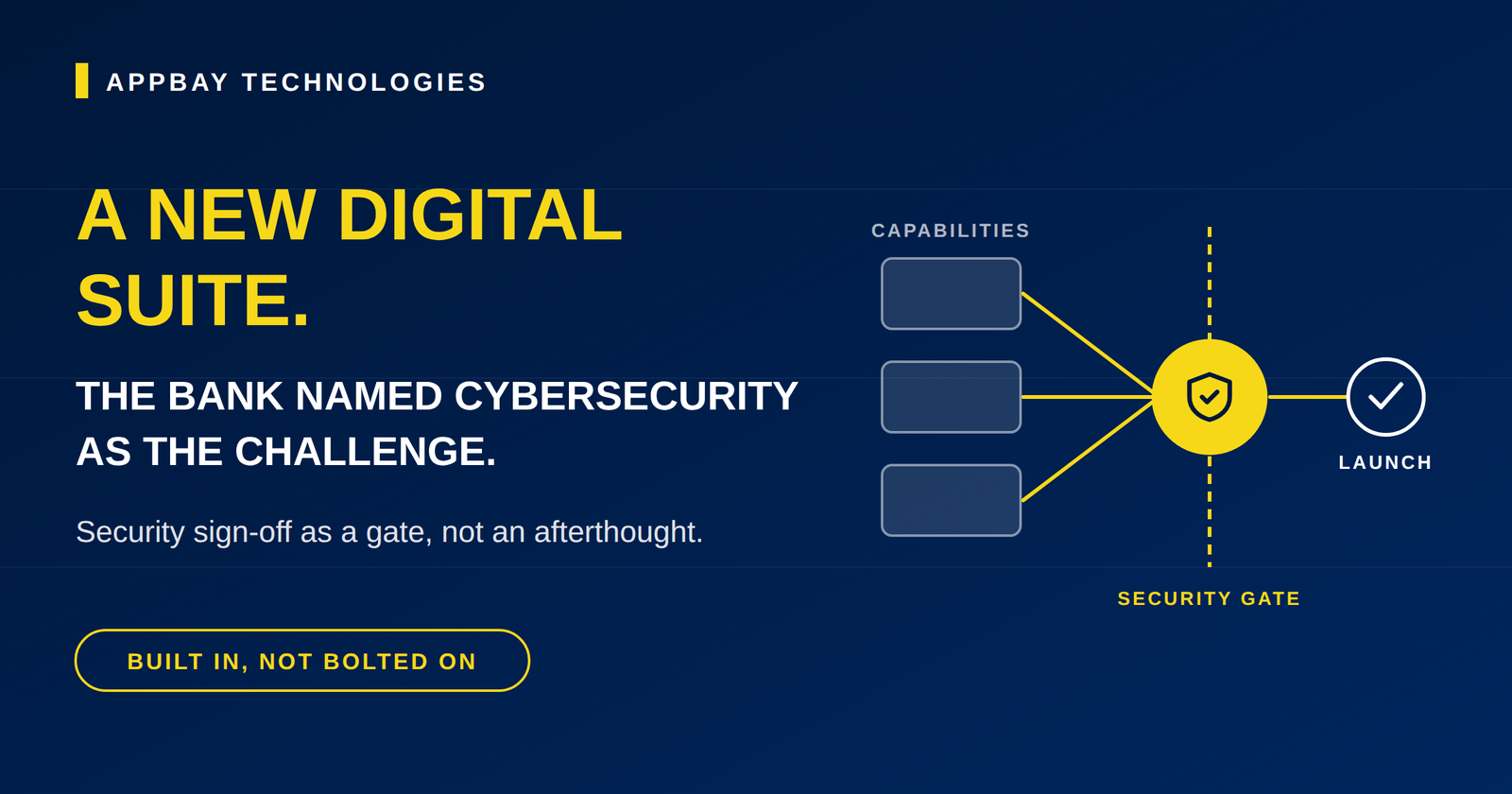
The better path combines Appbay’s ComplianceIQ Regulatory Radar and Master Compliance Copilot, extended into a cross-channel operational continuity workflow that applies both engines to incident detection and response -not just regulatory compliance, which is what they were originally built for.
Neither product was designed for operational continuity specifically, but the underlying pattern transfers directly: detect, flag, assign an owner, track resolution, escalate when needed.
1. Incident and Exception Ingestion, Any Channel
Retail and corporate incidents feed into one system -not two separate monitoring setups hoping to line up.
2. AI-Driven Pattern Correlation
Related incidents across channels get connected automatically, surfacing patterns that would otherwise look unrelated from inside a single channel’s view.
3. Ops Review
A person evaluates every flagged incident before action is taken -automation surfaces the correlation, it doesn’t make the call.
4. Appian-Orchestrated Escalation
One governed escalation path applies, regardless of which channel the incident originated from.
5. Audit Trail
Every incident and every response is traceable, CBK-ready from day one.
6. Unified Dashboard
One continuity view across every channel -not five separate dashboards that someone has to manually reconcile during an actual incident.
This turns “full continuity across all channels” from a stated commitment into an operational reality -one unified view, instead of separate playbooks hoping to stay in sync.
Proof, Not a Full Continuity Rebuild
- 8–12 week proof of concept-scoped to unifying continuity monitoring for one channel pair first
- AI-driven pattern detection-correlating incidents across channels from day one
- Human ops review retained-automation surfaces the correlation, a person makes the final call
- Appian-orchestrated audit trail-one consistent, defensible record across every channel
- Unified continuity dashboard-proof, in real time, that the commitment is holding evenly
This isn’t a full continuity-program rebuild. It’s a fast, scoped proof that one channel pair can genuinely share a unified view-before extending it across retail and corporate.
This Pattern Isn’t Unique to One Bank
Any institution committing to continuity “across all channels” during a genuinely volatile period will face the same coordination gap: retail and corporate were never built to share one incident view, and that gap stays invisible until volatility tests it directly. The banks getting ahead of this aren’t waiting for volatility to expose the weakest link. They’re unifying the response before it’s needed.
Let’s Compare Notes
We’re working with banks across the GCC building unified continuity across retail and corporate channels-same volatility, same challenge. If your organization has made a similar commitment, we’d welcome the conversation.
Send us a message to discuss your operational continuity approach.