
By Appbay Technologies
Opening the doors makes the headline. Onboarding customers compliantly in each market is the work that follows.
A UAE bank is operationalizing new branches in Saudi Arabia and Egypt, aiming to grow market share and take advantage of the opportunities under Vision 2030. Opening a branch is a visible milestone. What sits behind it is less visible: every customer has to be onboarded under the rules of the market they are in.
This piece is a candid one. The fit is a good one with some configuration work, and we’ll be specific about which parts are which.
The Priority: Growing Market Share Through New Markets
Increasing market share by operationalizing new branches, while diversifying across retail, corporate, and Islamic banking, is a clear and worthwhile priority. It is also a competitive one, where speed matters and each new market has its own regulator.
That creates a real operational question: can a bank onboard customers in a new market quickly without running a separate, hand-built process for each country?
The Hidden Problem: Compliant Capacity That Lags the Branch
Here’s where the operational gap can show up, inside a bank expanding into new markets:
- Customer files chased per market – documents and evidence requested in different formats for each country
- Two rulebooks, one team – the same people applying different requirements depending on the market
- AML checks re-keyed – the same information entered again as it moves between systems
- Accounts waiting to activate – new customers queued behind manual review
Why does this exist? Each market has its own KYC, AML, and reporting requirements, and a branch can’t serve customers until its controls work. Three business lines across two new markets multiply the product and compliance variants, while the home business keeps running. When onboarding procedures are adapted market by market, review depth and evidence formats vary from one jurisdiction to the next, and the compliance team becomes the pacing item for the whole expansion.
Why This Matters Now
The branches are open. When does each one pay back, with margins under pressure?
Yields repricing faster than funding costs raises the bar for new-market returns. The board backed two new markets, and it now wants payback and cost per customer, branch by branch. The question that follows isn’t rhetorical:
“How quickly is each branch earning, and what does each new customer cost to onboard?”
For the COO, CCO, and CFO, this plays out across four measures:
- Payback period per branch – how long each new branch takes to earn back its cost
- Cost per onboarded customer – the real cost of each onboarding, by market
- Cost-to-income, new markets – whether the expansion helps or hurts the ratio
- KSA branch revenue versus plan – how the new branches track against their promise
Without that visibility, each branch’s growth is capped by onboarding and compliance throughput, delaying the revenue the expansion was meant to bring.
An Honest Look at the Fit
We want to say this plainly: this is a good fit, with configuration work. Customer onboarding with KYC and AML is close to Appbay’s core strength. Appian suits jurisdiction-aware onboarding directly: intake, risk-tiered routing, review, sign-off, and audit trail.
What transfers directly:
- Document intelligence for customer files
- Audit IQ-style reporting for every decision
What is configuration work, not a ready product:
- Encoding each market’s own rules, which the bank’s compliance teams in each market have to define
Regulatory interpretation and final approvals stay with the bank. AI supports the analysis and does not make the call.
Here’s what that would actually involve:
Ingest Customer Documents
Customer files brought into one governed workflow, whichever market they come from.
AI Extraction and Checking Against Market Rules
Documents checked against the requirements of the relevant market, with gaps flagged.
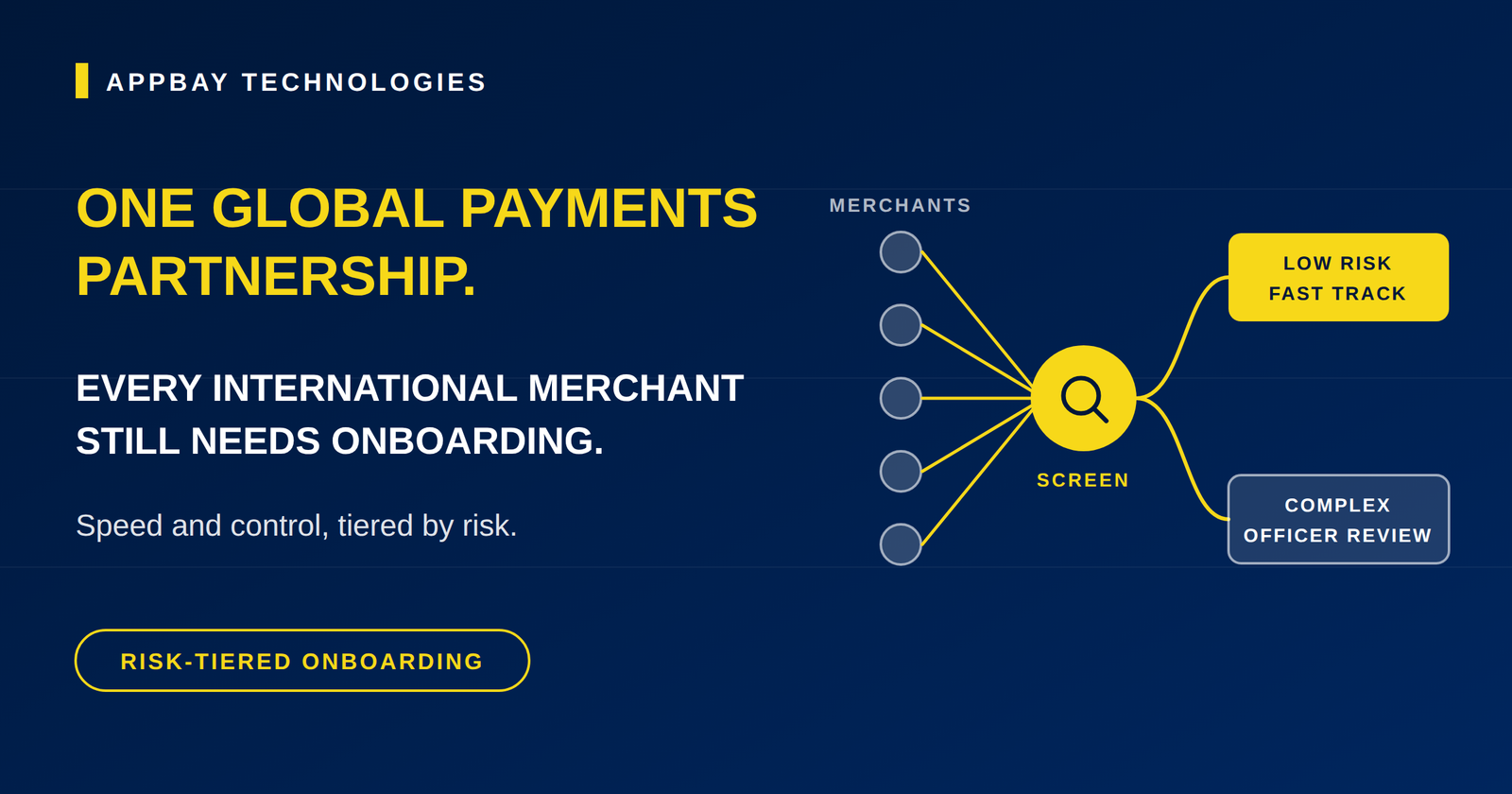
Auto-Route by Market and Risk Tier
Standard files move through quickly. Complex ones reach the right officer with the evidence already assembled.
Compliance Officer Approval
Every approval remains with a person.
Full Audit Trail
Every step and decision on record, in a consistent format across markets.
The practical starting point is a scoped 8-12 week proof of concept on one market and one segment, for example retail onboarding in one of the two markets, rather than both markets at once. It would show whether one workflow with market-specific rules shortens time-to-activate without loosening review.
Why We’re Saying This Plainly
Being specific matters more than a broad claim would. This problem sits close to what Appbay already builds, so the honest message is that we can scope it clearly, and that encoding each market’s rules is configuration work that depends on the bank’s own compliance teams. Naming that up front is more useful than overstating it.
This Pattern Isn’t Unique to One Bank
Any institution expanding into new markets will face the same constraint: branches can open on schedule, but compliant onboarding capacity depends on how well each market’s rules are built into the process. The banks getting ahead of this run one workflow with market-specific rules, rather than a separate process per country, and prove it on one market first.
Let’s Compare Notes
We’re curious how other banks are onboarding customers across new markets without running a separate process for each. If your organization is working through the same challenge, we’d welcome the conversation.
Send us a message. This one’s genuinely about comparing notes, not a pitch.