
By Appbay Technologies
A funding programme makes the headline. Clearing each new investor, without loosening screening, is the work that follows.
A Gulf wholesale bank recently established a US$3 billion Certificate of Deposit Programme to diversify its funding and widen its access to short-term wholesale markets. A named programme like that signals intent. It also creates a queue, because every new institutional investor has to be onboarded, screened, and documented before the first deposit.
This piece is a candid one. The fit is partial, with one part close to what we already build and one part that would be new, and we’ll be specific about which is which.
The Priority: Diversifying Funding Through a Named Programme
Diversifying funding sources, strengthening the funding platform, and enhancing market access are clear and sensible priorities for a wholesale bank. A US$3 billion programme gives them a concrete shape. It also depends on one practical thing: how quickly a new investor can be cleared to transact.
That creates a real operational question: is investor clearance a repeatable process that scales with investor interest, or a case-by-case effort that caps the programme’s reach?
The Hidden Problem: Clearance Capacity That Doesn’t Scale
Here’s where the operational gap can show up, inside a bank onboarding institutional investors:
- Institutional KYC files chased – documents arrive in varied formats from multiple jurisdictions
- Cross-border checks repeated – the same checks run again file by file
- Treasury waiting on clearance – the funding desk can’t transact until a counterparty is cleared
- Compliance triaging by hand – review depth set case by case
Why does this exist? A programme that reaches regional and international investors brings new investor types, each with its own documentation. Short-term funding means frequent issuance, so the checks recur at pace and compliance touches a rising share of transactions. Banks in this position often find that clearance is handled case by case, so demand scales with investor interest while review capacity scales with analysts.
Why This Matters Now
The programme was established. How much of the funding now comes from the market?
A programme on paper isn’t a funding mix that has moved. The question that follows isn’t rhetorical:
“Is the funding mix moving, and how quickly can a new investor start contributing to it?”
For the CFO and Head of Treasury, this plays out across four measures:
- Funding mix versus target – how much of total funding comes from the programme
- Cost of funds trend – whether diversification is improving the price of funding
- CD investors by jurisdiction – how broad the investor base is, and where it sits
- Time-to-onboard an investor – how long a new counterparty waits before it can place a deposit
Without a fast, repeatable clearance process, investor interest can outrun the capacity to onboard it.
An Honest Look at the Fit
We want to say this plainly: this is a partial fit. Institutional investor onboarding is close to Appbay’s core strength in KYC and AML workflows, so that part transfers well. Other parts would be new.
What transfers directly:
- Document intelligence for corporate and institutional files
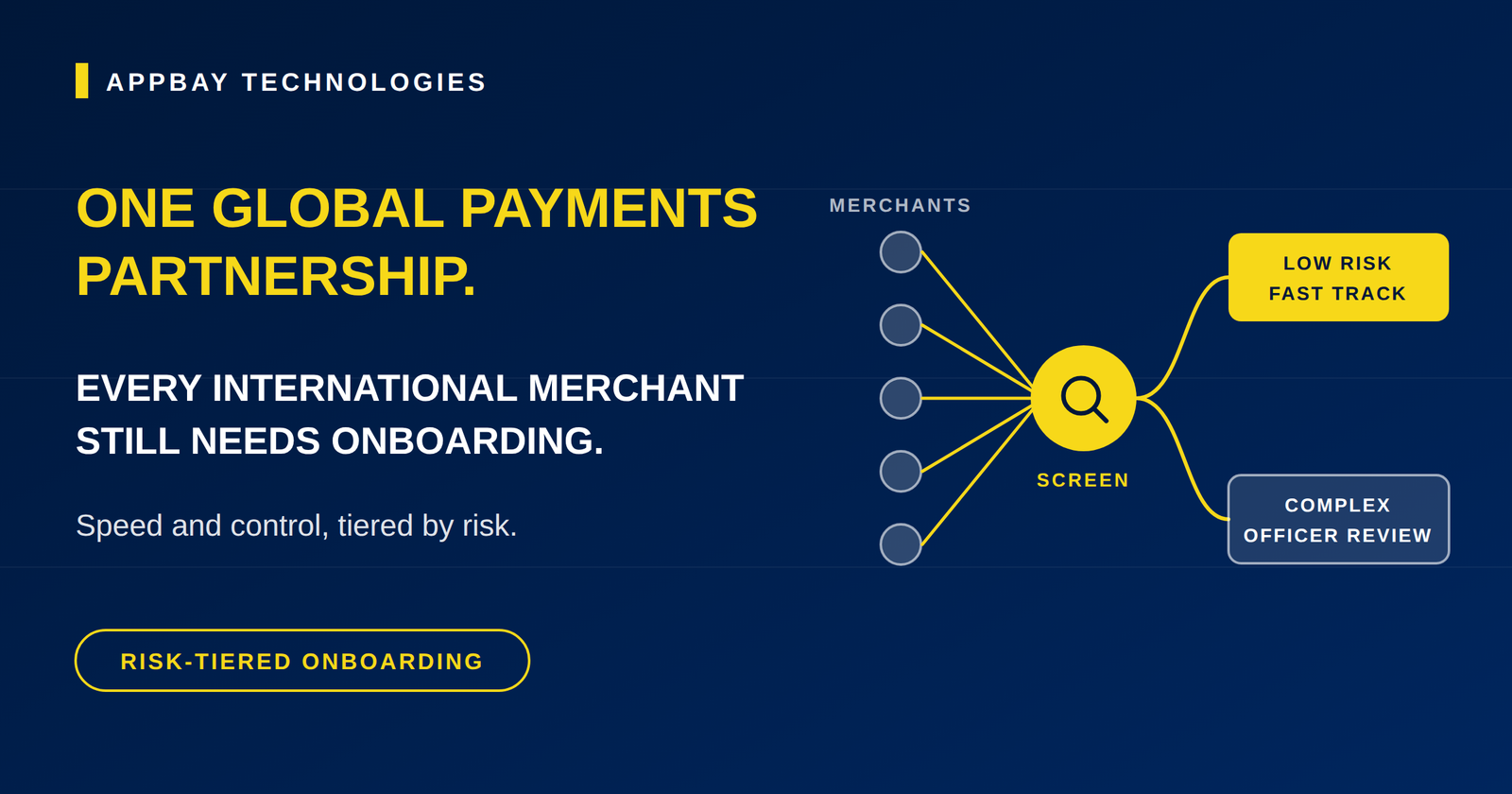
- Risk-tiered routing so familiar institutions move quickly and complex ones reach the right officer
- Audit IQ-style auditable reporting for every clearance
What is new configuration or build work:
- Investor-limit and programme-specific rules for a CD issuance
- Funding-mix and diversification reporting, which is a genuine analytical build rather than a repurposed product
Investor acceptance decisions and funding strategy stay with the bank’s treasury and compliance functions. AI supports the analysis and does not make the call.
Here’s what the onboarding part would actually involve:
Ingest Institutional Documents
Corporate and institutional files brought into one governed workflow.
AI Extraction and Checking
Files that arrive in different formats structured into a consistent view and checked against the bank’s own requirements.
Auto-Route by Risk Tier
Familiar institutions move through quickly. Complex ones reach the right officer with the evidence already assembled.
Compliance Officer Clearance
Every clearance remains with a person.
Full Audit Trail
Every step and decision on record.
The practical starting point is a scoped 8-12 week proof of concept on one investor segment, for example new international institutional investors. It would show whether risk-tiered clearance shortens time-to-onboard without loosening screening. It would not cover the full programme, and the funding-mix reporting would be a separate, larger conversation.
Why We’re Saying This Plainly
Being upfront matters more here than a confident pitch would. The onboarding workflow is close to what we build. The programme-specific rules and the funding-mix reporting are not. Naming that clearly and starting with one segment is more useful than stretching an existing product to cover both.
This Pattern Isn’t Unique to One Bank
Any institution opening a wholesale funding programme to a wider investor base will face the same constraint: programme reach grows with investor interest, but KYC and cross-border screening grow with analysts. The banks getting ahead of this treat risk-tiered clearance as part of the programme design from the start, not as a clean-up exercise after launch.
Let’s Compare Notes
We’re curious how other treasury teams are onboarding institutional investors faster without loosening screening. If your organization is working through the same challenge, we’d welcome the conversation.
Send us a message. This one’s genuinely about comparing notes, not a pitch.