
By Appbay Technologies
A UAE bank became the first in the market to fully activate Open Finance-while naming uninterrupted banking services a top priority in the same strategy. It’s a genuine leadership move, and it made every headline it deserved.
Every new third-party provider connection now tests both commitments at once.
This is the tension that never makes the press release.
The Strategic Priority
Being first to activate Open Finance is a clear strategic advantage. It signals regulatory readiness, a genuine head start on the third-party provider ecosystem, and confidence that the bank can lead rather than follow.
But being first also means there’s no established playbook to fall back on. Every subsequent TPP onboarding is also a first for the bank’s own process-happening at the same time the bank has publicly committed to zero service interruptions.
No established playbook. Every TPP onboarding is a first for this bank’s own process, too.
The Operational Reality
Here’s where it actually breaks down operationally:
- Each new TPP connection is a new integration point, and a new potential threat to the continuity commitment made in the same breath
- Onboarding speed and service continuity pull in opposite directions-move fast to sustain the first-mover advantage, or move carefully to protect the uninterrupted-service promise
- No clear way, when an incident occurs, to say definitively whether a specific TPP connection was involved
Why does this exist? Being the first bank to fully activate a regulatory framework means the bank itself is defining its own onboarding and governance process in real time, not adapting an existing one. That’s exactly where speed and stability start working against each other instead of together.
What the Board Will Ask
The bank went first on Open Finance. Now the board wants proof.
Being first draws scrutiny both ways: too slow undercuts the advantage, too fast risks the interruption they’ve publicly ruled out. The question the board actually asks:
“Can you prove no TPP has touched service continuity?”
For a COO or Chief Digital Officer, that question doesn’t wait for an incident to get asked. Two priorities named together, publicly, in the same strategy create a standing obligation to show neither was compromised for the other.
The Path Forward
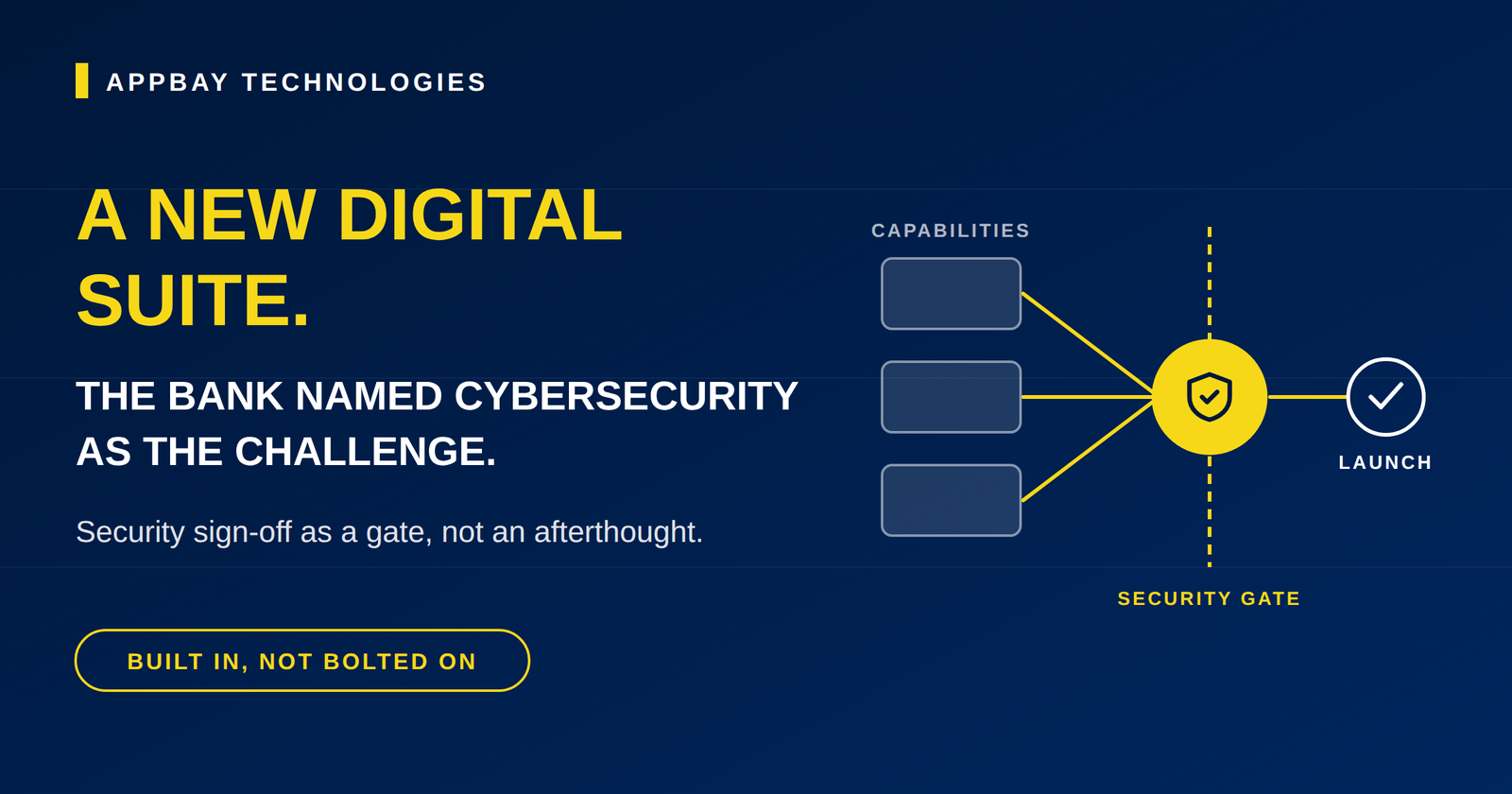
The answer isn’t slowing onboarding down to protect continuity, and it isn’t racing ahead at the cost of stability. It’s building a continuity checkpoint directly into the onboarding process, so speed and stability stop trading against each other.
This is where Appbay’s Universal Identity Copilot and Master Compliance Copilot come together-extended with a continuity-risk checkpoint purpose-built for this exact scenario.
Here’s the flow:
Step | What Happens |
1. TPP documentation ingestion | Security and compliance documents for every new provider enter one system |
2. AI compliance and continuity-risk flagging | Each TPP assessed for compliance gaps and potential impact on service stability |
3. Human sign-off | Every flagged risk reviewed and judged by a person before go-live |
4. Appian-orchestrated workflow | A governed, auditable approval path for every TPP |
5. Audit trail | Every onboarding decision traceable back to its risk assessment |
6. Go-live, with an incident-correlation dashboard | Tracking which TPP, if any, is linked to a service disruption |
Both products’ core capability-verify, compare against policy, flag risk-transfers directly. The genuine new work is the continuity-checkpoint layer itself: an explicit stability check built into the sign-off, not just a compliance check.
Proof Before Scale
- 8-12 week proof of concept-scoped to one TPP category
- AI-driven compliance and continuity-risk flagging-applied consistently from day one
- Human sign-off-built into the workflow, not bypassed
- Appian-orchestrated audit trail-every onboarding decision traceable and defensible
- Incident-correlation dashboard-proof the continuity checkpoint actually holds before it scales to the next TPP category
This isn’t a bet-the-program governance overhaul. It’s a fast, scoped proof that onboarding speed and service continuity can coexist-on one category-before extending it further.
Why This Isn’t Unique to One Bank
Any bank in a genuine first-mover position on a regulatory framework faces this same structural tension: no established playbook to inherit, and every subsequent action measured against a continuity promise made in the same breath as the first-mover claim.
The institutions getting ahead of it aren’t waiting for an incident to find out whether their onboarding process can tell the difference between a platform issue and a TPP issue.
Let’s Compare Notes
We’re working with banks across the GCC balancing Open Finance speed with service continuity-exactly this tension. If your organization is navigating a similar first-mover position, we’d welcome the conversation.
Send us a message to discuss your TPP onboarding and continuity roadmap.